SHOWCASE

/ ARTIST / 2026

ARTIST: Jean8lines
COUNTRY: Thailand
CONTACT: https://jean8lines.my.canva.site/
https://www.instagram.com/jean8lines/
https://www.youtube.com/@jean8lines/
My name is Jinjutha Panich, or Jean(s), the artist and mind behind Jean8lines. With a background in psychology and a love for storytelling, I create psychological horror illustrations that reflect the emotional struggles we often keep hidden. My work doesn’t aim to scare; it uses the uncanny to shift perspectives, spark introspection, and invite viewers to gently face their darkness. I aim to help others see beauty in the eerie and find meaning in the unknown, encouraging them to embrace the parts of themselves often left in shadow as part of healing. My dream is to share this message worldwide: that even your darkness, even your rawest self, is worthy of your love and kindness.

Evolving this vision, my latest work blends visual art and literature through the concept of visual bibliotherapy, incorporating interactive elements like puzzles, word riddles, and choice-based mechanics. By turning self-reflection into an engaging, immersive narrative experience, I aim to deepen how these messages resonate.

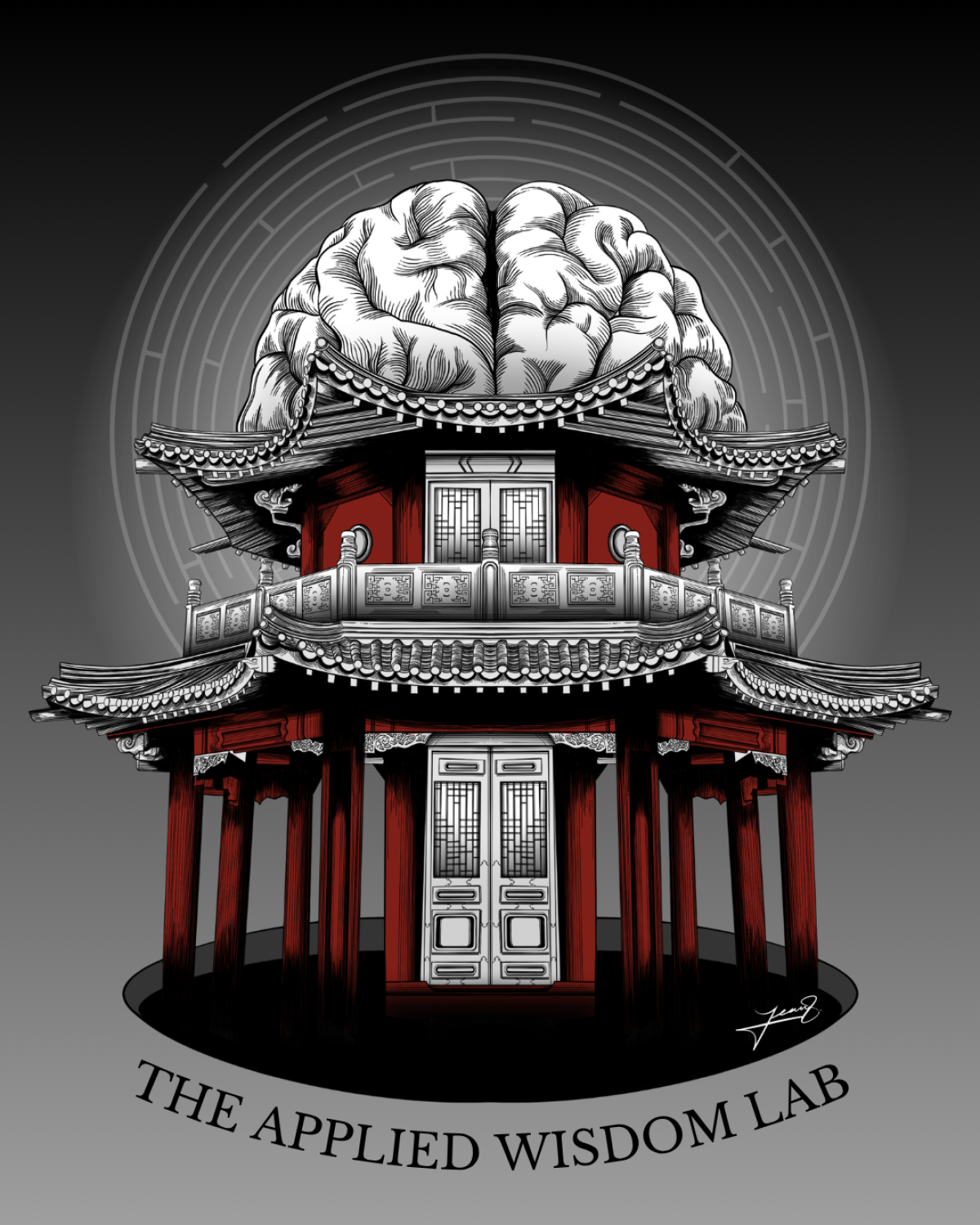
The Applied Wisdom Lab

An ancient temple rises from the landscape, but where a roof should be, there is a brain.

The structure becomes both sanctuary and laboratory. A place where knowledge is not only preserved, but interpreted.

The temple represents the cultural values, narratives, and collective beliefs that shape the foundations of human perception. Long before people consciously define who they are, they begin absorbing ideas about what is admirable, acceptable, possible, or expected. Over time, these messages become woven into identity, influencing how individuals understand themselves, others, and the world around them.

Yet the brain atop the temple suggests movement rather than permanence. Beliefs can be inherited, but meaning is continuously constructed through experience, reflection, and growth.

The Applied Wisdom Lab reflects the ongoing dialogue between internal and external influences. Between collective narratives and personal understanding. Between the assumptions we absorb and the perspectives we consciously choose to cultivate.

Some beliefs become foundations. Some become questions. Some become doors. The work invites a moment of curiosity:

Which parts of the self emerged through lived experience?
Which parts were shaped by the environments that surrounded it?
And which parts are still evolving?

Growth begins not when every answer is found, but when there is willingness to examine the stories that shape perception and the courage to keep exploring beyond them.
The Seeker

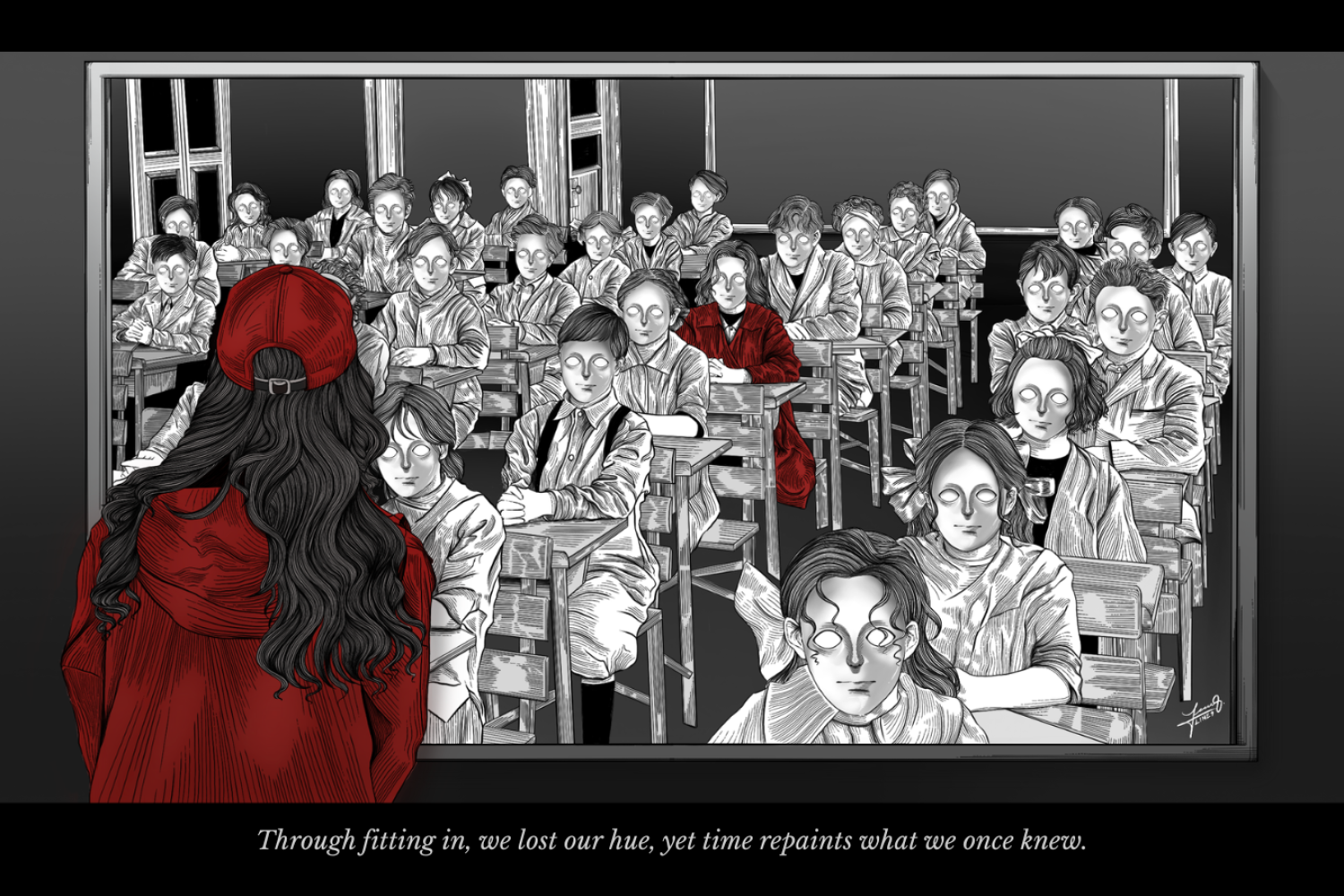
A girl stands before an old framed black-and-white photograph filled with students in masks. Inside the picture, one child begins to turn red, her hues slowly mirroring the one watching her.

This work is about finding ourselves by looking back, through retrospection, through memories, through time. Not every version of us is one we understand or feel proud of. Some are the versions that lost themselves trying to fit in, to feel accepted, loved, or simply safe. Yet even in those moments of confusion, we were still finding our way back to ourselves.

Every past version of ourselves, masked or unmasked, is part of our journey, a fragment of a greater story that shapes who we are today.

The perspective is a frame within a frame, a picture within a picture on purpose: to blur the line between the art and the observer (‘the seeker’).

And maybe, one day, a future version of us will look back at us now, at who we are right at this very moment, and understand something new about ourselves.

8oardgame: A Game Called Life

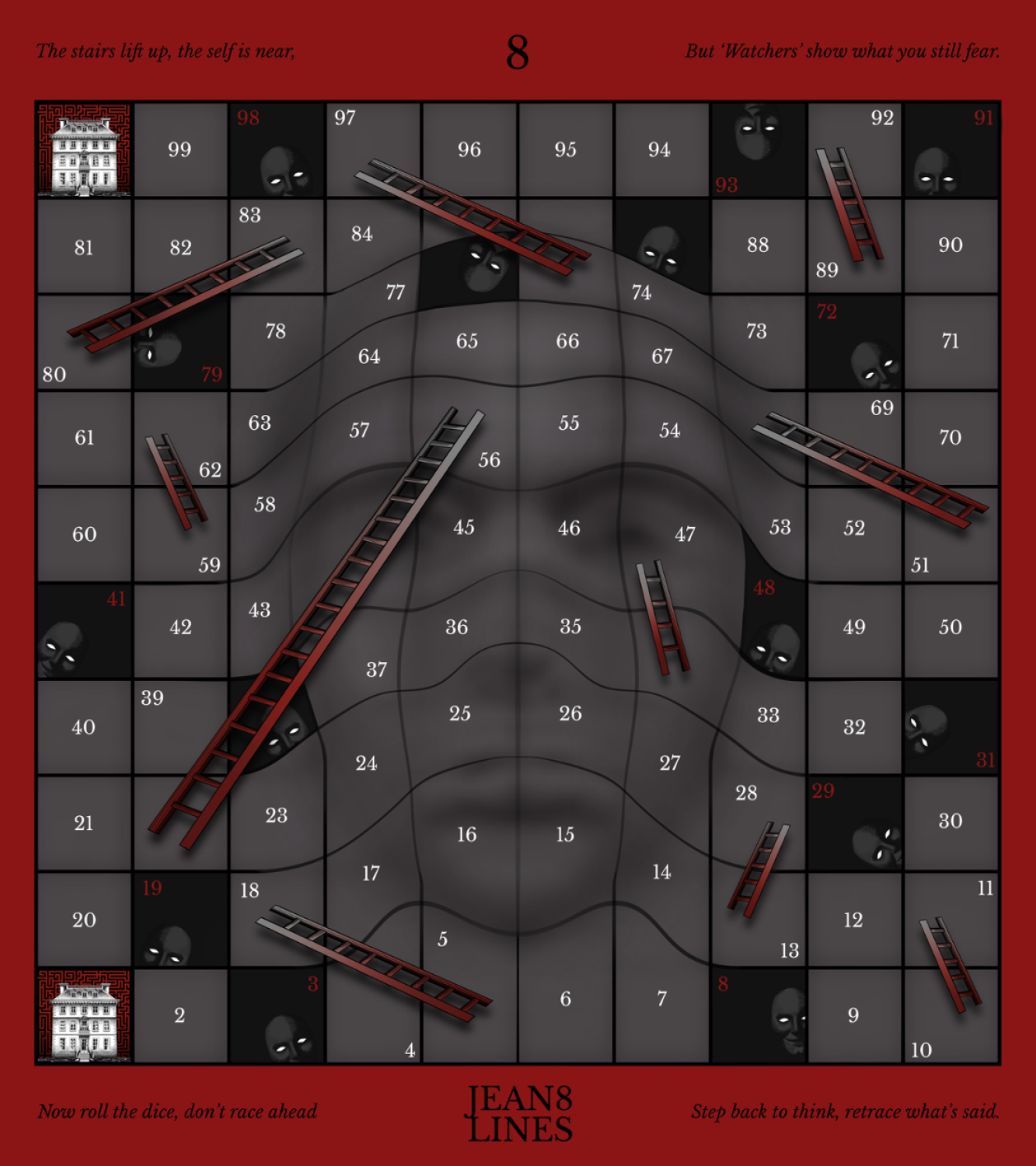
This work is inspired by the metaphor “life is just a game”, but with a twist according to my interpretation in a form of snakes and ladders board game.

The black tiles appear instead of snakes with my character “The Watcher” a symbol of the shadows or the uncanny within us, the darker or unpleasant parts of ourselves, our journey that we often fear confronting.

The entire piece is an optical illusion of a human face symbolizing the journey inward, where every roll of the dice represents a step through the complexity of the self. The optical illusion itself is a metaphor, a face only emerges when viewed from a distance; likewise, our deeper self reveals itself through patience, perspective, and reflection.

The rules of the game mirror life, when you roll and land on “The Watcher”, you must roll again, but this time backwards. This process represents the need to pause, reflect, acknowledge, and accept even the most difficult parts of ourselves before we can move forward again. The stairs, like in the classic game, offer moments of sudden forward movement.

The starting and finishing points both begin and end with “The Mazed Mansion”, my past work, reminding us that the mind is, has always been, and always will be, a complex, never-ending maze of thought, memory, and identity.

I want this work to remind anyone who comes across it that this game, “this journey” is not about winning or losing, it’s about understanding and acceptance. Each setback, each climb, each encounter with The Watcher is part of the larger picture of deeper understanding of self. The ending is neither “winning” or “completion” in the traditional sense, but the realization that the path, the uncertain, and complex, is the essence of self-love and self-acceptance.

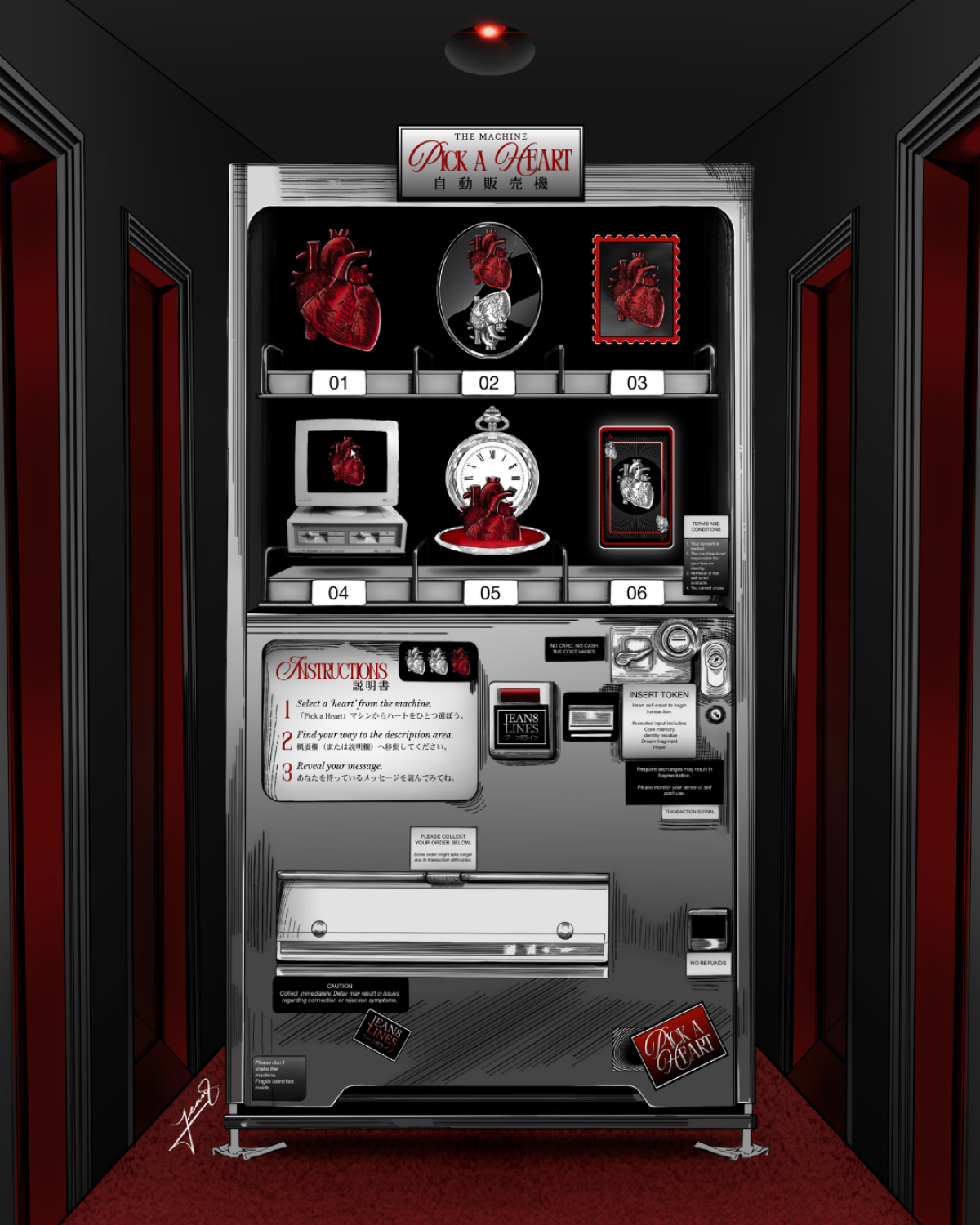
The Machine: Pick a Heart Edition

How to: Choose one heart from the "Pick a Heart" machine to discover the message meant for you.

01: The Beating Heart - Your heart was never meant to prove its worth through productivity alone. It still kept you alive through every emotion, every uncertainty, and every battle. Some days, surviving through different emotions is already a form of resilience. Even if no one notices how hard you’ve been trying, your nervous system does. And it still chose to keep going.

02: The Reflected Heart - Not every emotion needs to be corrected or justified before it deserves compassion. Sometimes the harshest reflection comes from the way we speak to ourselves. You don’t need to earn the right to feel what you feel. You deserve gentleness from your own heart too.

03: The Heart Stamp - Every experience leaves emotional traces behind us. Some wounds, comforts, and memories stay longer than we expect. But your past emotional “stamps” are not your final identity, and your heart is still capable of collecting new, softer emotional meanings too.

04: The Pixelated Heart - Not every emotion becomes clear immediately. Some feelings need time before they fully make sense. You do not need to rush yourself just because you can’t explain everything yet. Clarity often arrives gently, at its own pace, with patience and understanding, not always instantly.

05: The Timed Heart - Hearts process experiences differently even when experiencing similar things because every heart has survived different things. There is no “correct” speed for becoming okay again. Your healing does not become less valid simply because it takes longer than someone else’s; it is allowed to move at its own pace.

06: The Ace of Hearts - Feelings are not something you always have full control over, just like the cards life draws for you. But being able to stay emotionally honest and still feel deeply, despite everything you’ve experienced, is already a form of strength and great courage.

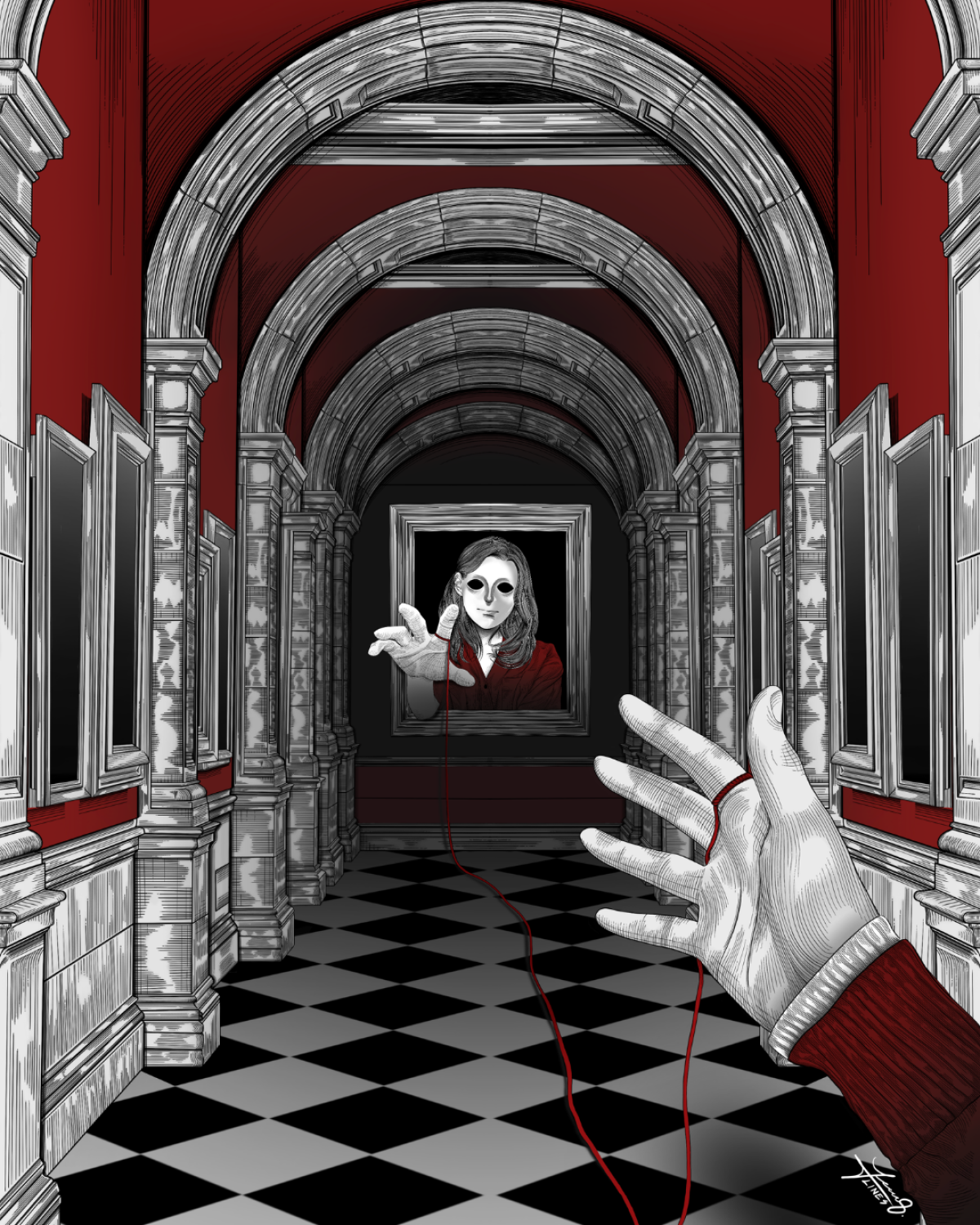
The Reaching Hands

At first glance, you may think this is just another regular horror art, a dark hallway, a girl trapped in a picture frame, her hand reaching out towards the viewer, the fingers connected by a red thread. But this time, that girl is actually a reflection of a past self: the idealized identity once built to please others, to fulfil or live up to their dreams and expectations, for the sake of making them happy and proud. Yet in that pursuit, she remained trapped in the dark endless corridor of other people’s definitions, overshadowing her will to acknowledge who she really was.

That hallway and the framed girl also represents the parts of ourselves we’d rather not face, the darkness, the unpleasant memories, the versions of us we try to bury or hide.

The red thread links the girl in the frame to the hand reaching out, a symbol of the inseparable bond with our past. So often, we see this bond as something that pulls us back, weighs us down, tethering us to pain, making us believe the only way forward is to cut it off or bury it in the dark.

The thread doesn’t have to only lead us into the dark. If we see it as bidirectional, then we can also hold the choice to pull that thread gently toward the light, accepting that even the darkest versions of ourselves are parts of us.

Because the truth is, light and darkness are always intertwined. One cannot exist without the other. What’s the meaning of happiness without sorrow, or self-love without the will to embrace what we’d rather hide?

The past doesn’t need to be erased, hidden, or denied in order for us to grow. Sometimes, healing means reaching back, taking the hand of that shadowed version of ourselves, and walking forward together, into the light.

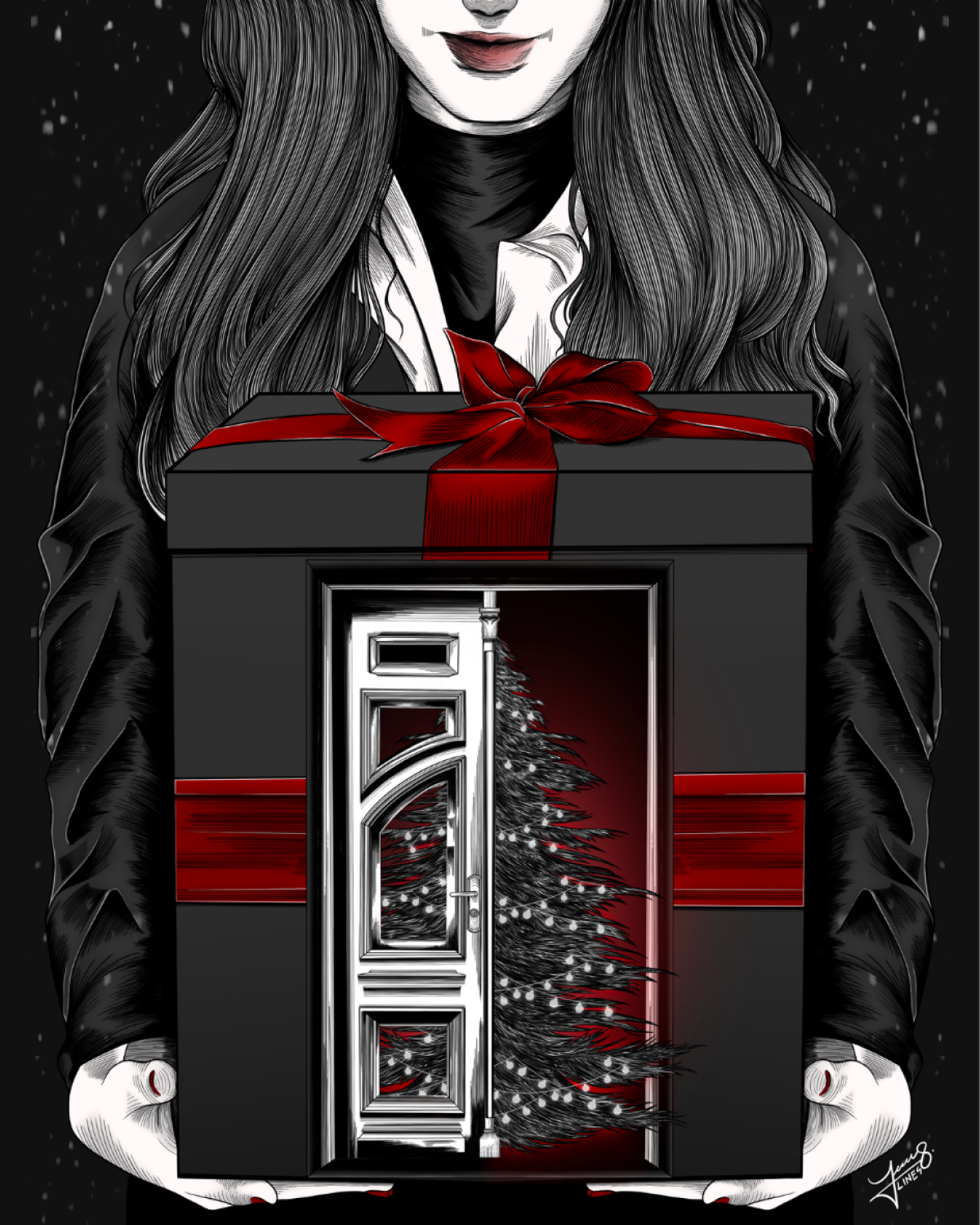
The Present

A girl holds a present large enough to feel its heaviness, almost overwhelming. From the outside, it looks like any other present we’re taught to wait for, something wrapped, sealed, and meant to be given by someone else. But instead of a familiar box, there’s a door. And inside that door is not just emptiness, nor another uncanny mystery, but a Christmas tree glowing in the dark, lit from within.

This work is about the kind of present no one else can give or prepare for you. Santa doesn’t know you the way “you” do. He didn’t walk with you through your memorable moments or your difficult ones. He wasn’t there with you when you felt lost, or stayed when things got rough, or overcome your fears the way you had to. The most meaningful, irreplaceable gift you’ll ever receive can’t come from outside, it comes from you.

And maybe that’s the magic of the season: when you learn to open yourself with care, you start to notice the love that’s already been there all along. When it’s no longer something you’re searching for, it naturally spills outward; shared not because you have to, but because you have enough.

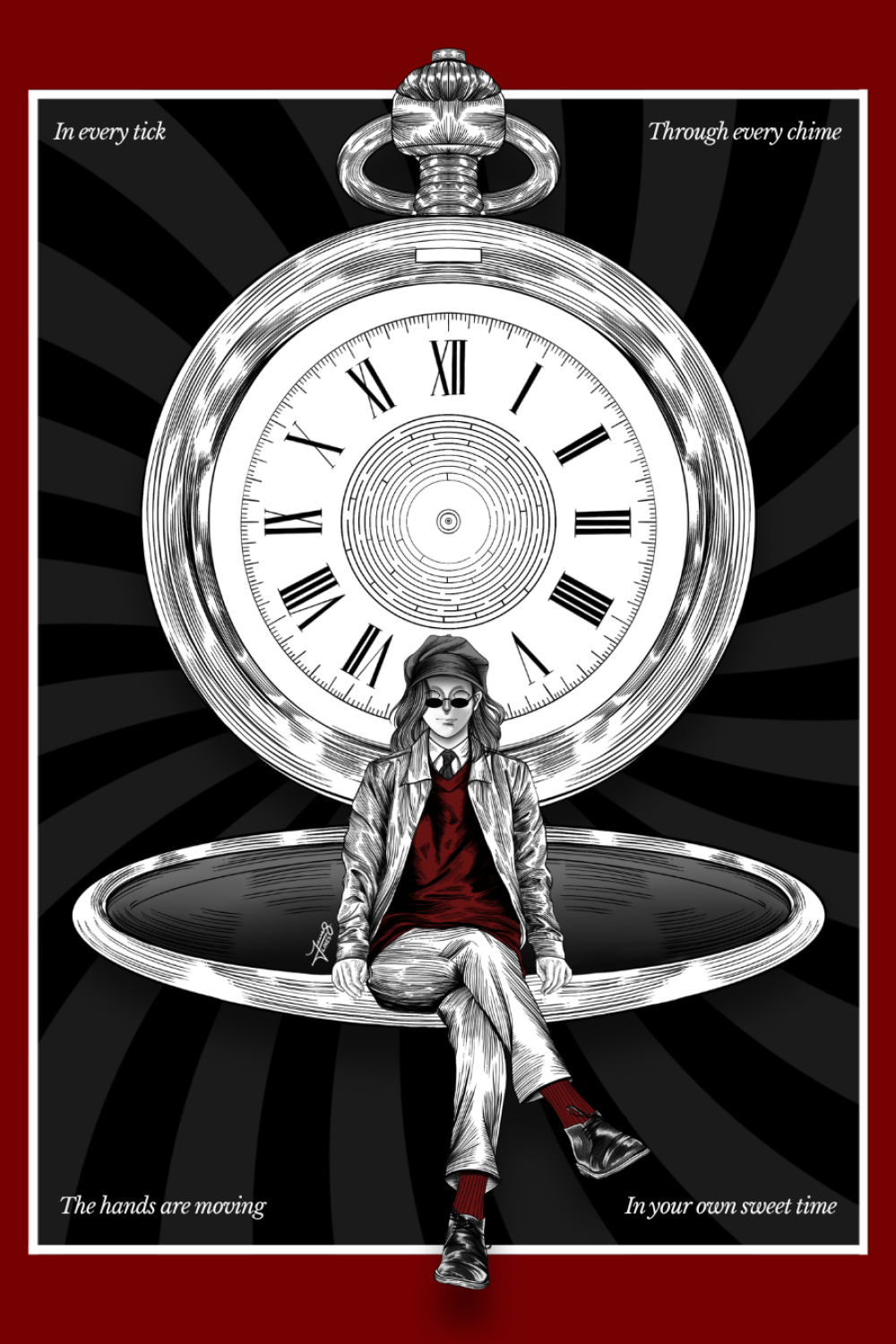
The Mysterious Watch

A clock without hands, a pocket watch that cannot measure, rush, or dictate. At its center sits a mysterious figure, positioned in a way that slightly bends perspective, as if aware of being observed.

Without hands, the clock cannot point to “too early” or “too late.” It cannot accuse. It cannot compare. It simply exists.

At its center lies a circular maze, symbolizing the complexity of timing itself. Growth, healing, success, identity; none of these unfold in straight lines. They pause, loop, stall, and reroute. The maze suggests that what feels like delay may actually be navigation. What feels like being lost may simply be movement we don’t yet understand.

The gender-neutral figure with mask represents the self caught between expectation and inner rhythm. Society builds invisible schedules: when to achieve, when to arrive, when to become, or even when to feel. But time, as we experience it, is deeply personal.

The untimed watch questions the urgency we inherit and reminds us that not all clocks deserve our obedience.

You are not behind.
You are not late.
You are moving through your own maze, at your own pace.
And that is more than enough.

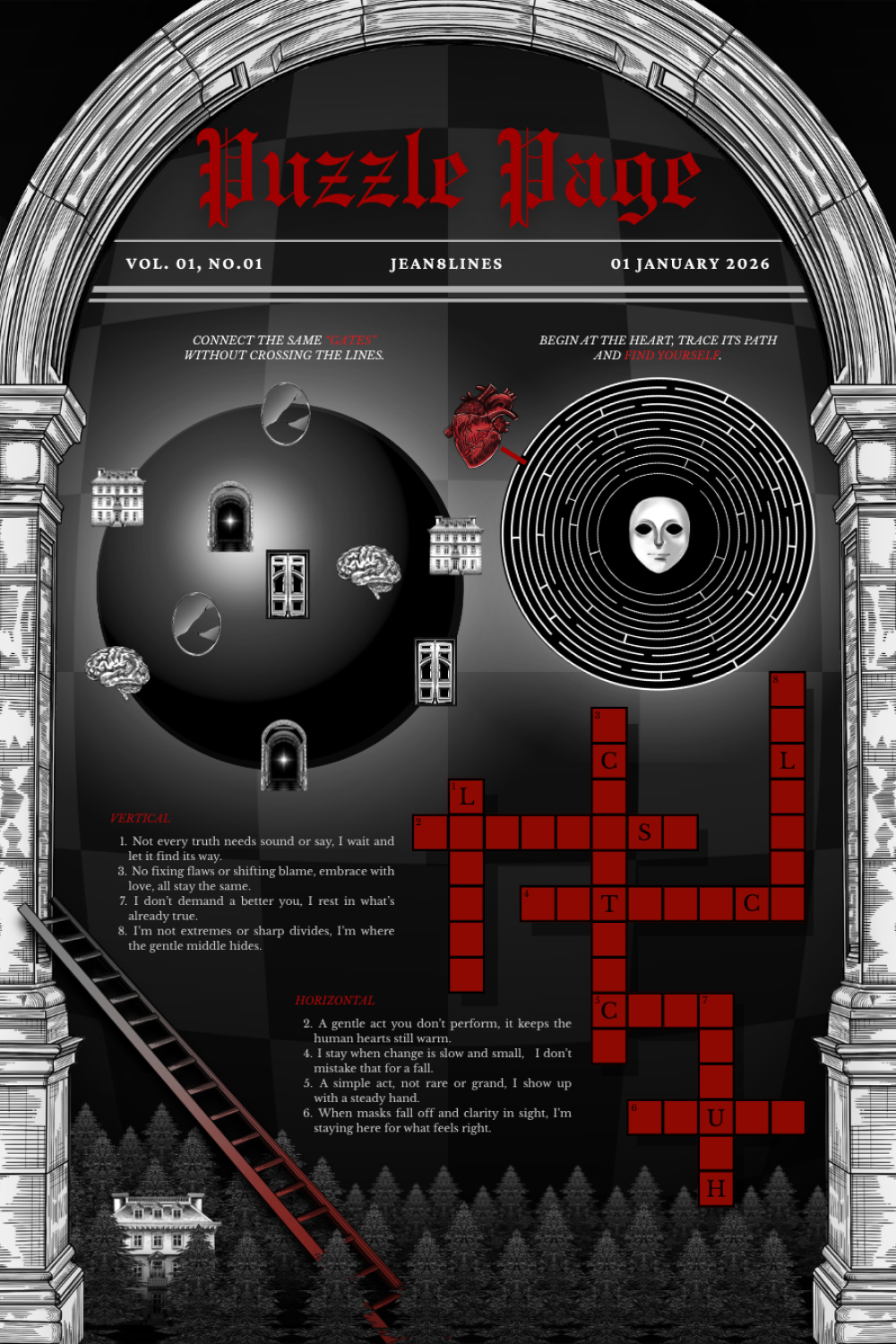
Puzzle Page Vol. 01

This is a solvable puzzle page, designed as an interactive way to connect, interact, and reflect upon different things within.

Task I: The gates ask you to connect what belongs together without disturbing what exists beside it.

Task II: The maze maps the distance between what you feel and who you are, turning the heart into a path toward the self.

Task III: Crosswords turn fragments into something whole.

Task IV: Word riddles wait in the spaces we don’t think to look, rewarding doubt more than certainty.

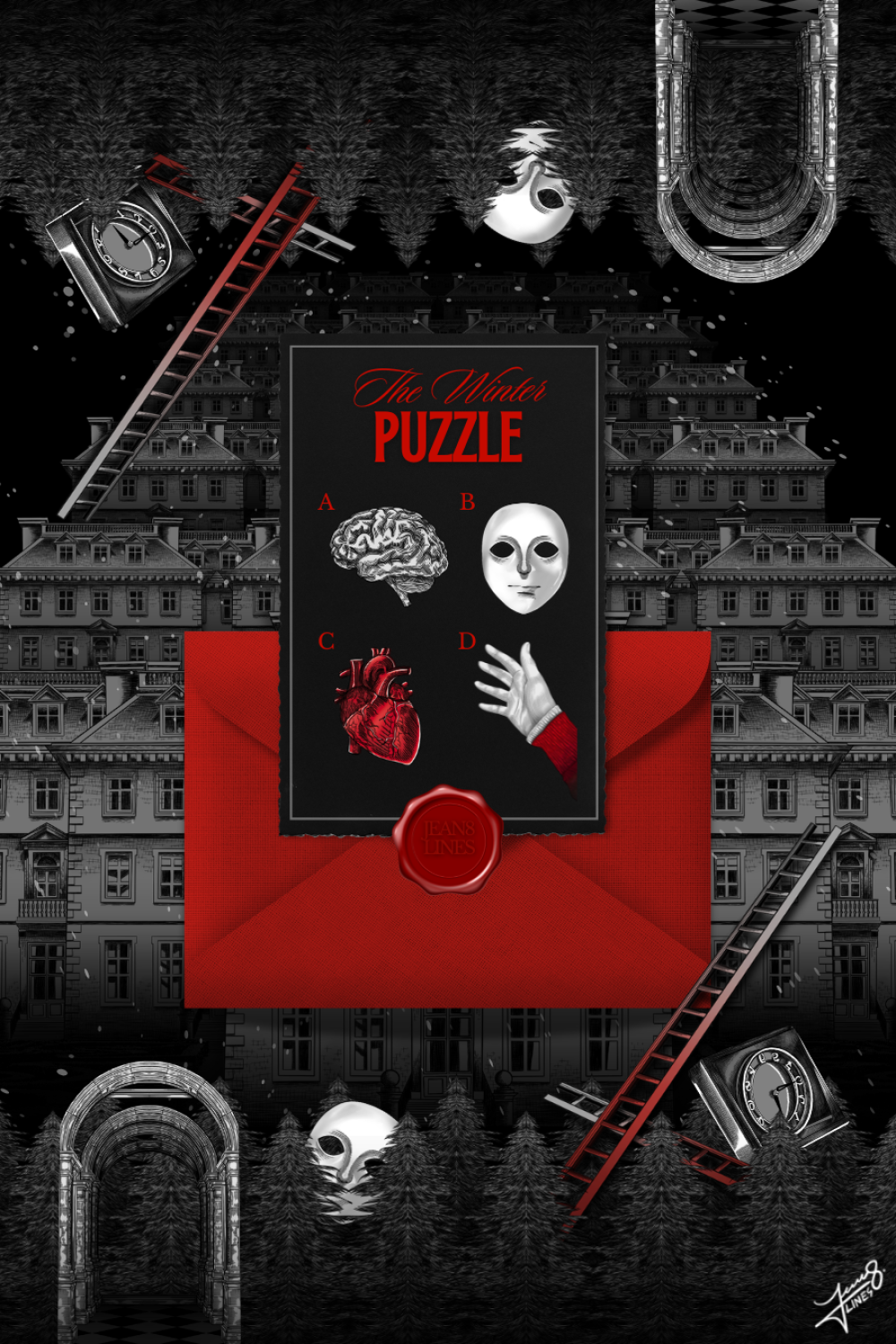
The Winter Puzzle

Concept: Each symbol represents a part of you: Brain for thoughts, Heart for feelings, Face for self-perception, and Hand for actions.

Instruction:
1. Choose a part: Brain, Heart, Face, Hand
2. Read the message.
3. Follow the mission.

A. Brain:
Every version of you, past or future, is rooting for the person you are today. They know how far you’ve come. You’re doing better than you realize.
Mission: Write one short message to your future self starting with: “I hope you remember that…”

B. Face:
Your heart has survived seasons and battles it never got credit for; the kind no one saw or understood, yet it keeps beating with a strength you rarely acknowledge.
Mission: List three things you’re thankful to yourself for; it could be anything, even surviving the day counts.

C. Heart:
Look closely. The person staring back has survived every version of you; every chapter, every ending, or every beginning. That alone is worth honoring.
Mission: Think of one trait you have that deserves more appreciation, even if it feels small or insignificant.

D. Hand:
You don’t need permission to treat yourself with kindness. Let yourself be held by the person who has carried you through every dark, long nights.
Mission: Slowly cross your arms over your chest and give yourself a 10-second hug.

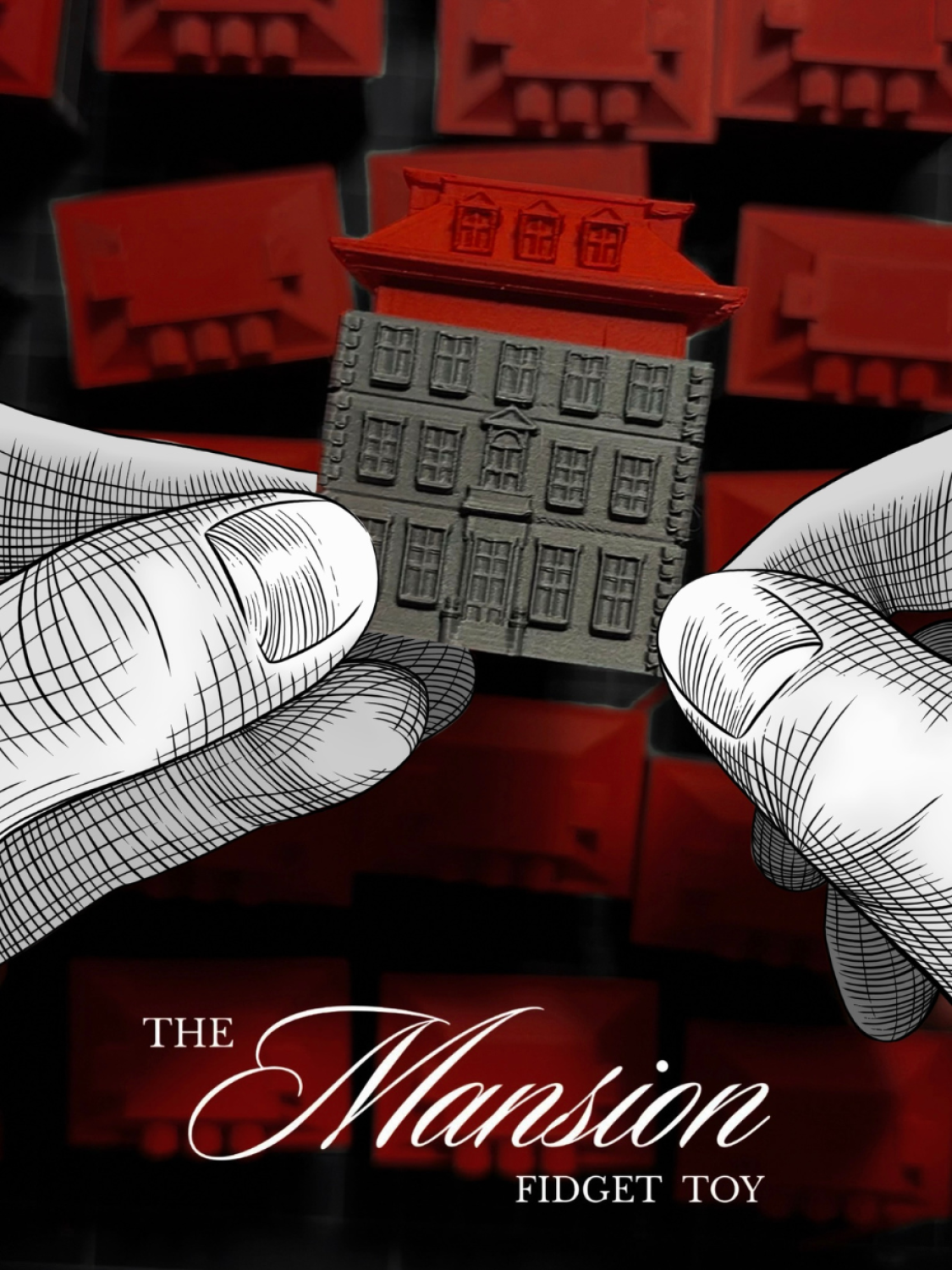
The Mansion Fidget Toy

The mansion symbolizes the complexity of the human mind. No matter how scary, confusing, or overwhelming this mansion may seem, it is still our home and it doesn’t have to be perfect to deserve our kindness.

As someone who fidgets constantly whenever anxiety or frustration hits, I deeply understand the daily struggles of dealing with anxiety and ADHD. I wanted to build a cool interactive tactile physical anchor for those moments. This fidget mansion toy is a tactile way to navigate your own inner mansion at your own pace in a cool and interactive way.